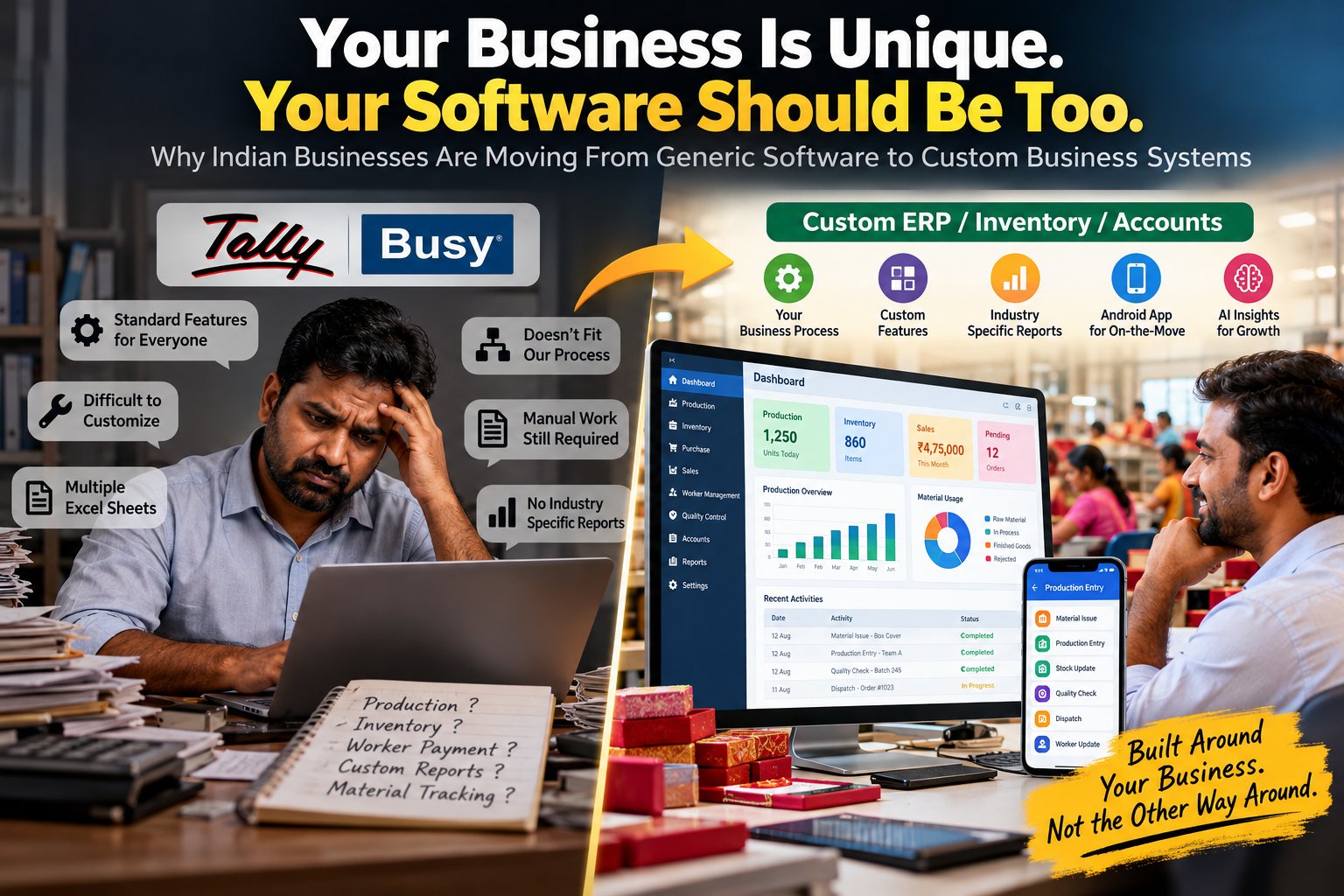
For years, businesses across India have relied on accounting and business-management software such as Tally and BUSY. These platforms have become familiar tools for managing accounts, invoices, taxation, inventory and everyday business operations.
And for many businesses, they work perfectly well.
But there is another category of business that often finds itself in a difficult position.
The business has its own processes.
Its own rules.
Its own production methods.
Its own reports.
Its own approval system.
Its own inventory workflow.
And sometimes, its own way of doing almost everything.
For such businesses, the problem is not necessarily that their existing software is bad.
The problem is that their business is different.
That is where custom business software becomes relevant.
The Problem With “One Software for Everyone”
Imagine thousands of companies using the same business-management platform.
One company manufactures garments.
Another distributes electrical equipment.
Another operates a packaging factory.
Another runs a jewellery-related business.
Another provides field services.
Another manages a specialized manufacturing process.
Their businesses are completely different.
Yet the software needs to provide a common framework that can work for all of them.
That is the strength of a general-purpose business application.
But it can also become its limitation.
A standard platform has to provide a large number of features, settings, options, workflows and configurations because it has to serve many different types of businesses.
As a result, the business often has to learn how the software works and then adjust its workflow accordingly.
That is perfectly reasonable when the business follows a relatively standard process.
But what happens when the business does not?
What If Your Business Doesn’t Work Like Everyone Else?
Consider a small manufacturing company.
Perhaps its process looks something like this:
Raw Material → Material Issue → Worker/Team → Work in Progress → Quality Check → Rework → Finished Product → Inventory → Dispatch
Now imagine that the company also needs:
- worker-wise production records
- team-wise production
- material consumption
- wastage tracking
- rejection tracking
- production costing
- custom payment calculations
- specialized inventory movement
- management reports
- customized approval processes
A general accounting application may handle parts of this process.
But the company may still need Excel sheets, notebooks, WhatsApp messages or manually maintained registers for the remaining processes.
Now the business has multiple systems.
The accounting software is one system.
Excel is another.
Paper records are another.
WhatsApp becomes another.
And employees may have to enter the same information more than once.
The software has not necessarily failed.
The business simply needs something more specific.
A Real-World Example: A Manufacturing Business With 150–200 Workers
Consider a manufacturing business where around 150–200 women work together in a large production facility, manually creating decorative boxes used by jewellery shops.
The production process is highly specialized.
Materials are distributed.
Work is assigned.
Workers or groups complete specific activities.
Finished and partially finished items return to supervisors.
Quality is checked.
Rejected items may require rework.
Finished products eventually move into inventory and are dispatched.
The business may have been operating for years using notebooks and manual records.
Why?
Not because the owner does not understand technology.
The reason can be much simpler:
The business does not fit neatly into a standard software workflow.
A custom system can be designed around the actual process.
For example:
Desktop Application
The main business-management system could handle:
- production
- inventory
- purchasing
- sales
- worker management
- material allocation
- quality control
- costing
- reporting
- accounts
- management dashboards
Android Application
The mobile application does not need to reproduce the entire ERP.
Instead, it can provide only the operations that employees need while moving around the factory:
- quick production entry
- material issue
- stock updates
- barcode scanning
- delivery confirmation
- worker/group updates
- approvals
- photographs
- field information
The desktop application becomes the control center.
The Android application becomes the business-on-the-move layer.
This is where custom software can become significantly more useful than forcing every business activity into one generic application.
Custom Software Does Not Mean “Tally Is Bad”
This distinction is extremely important.
Custom software should not be marketed by saying that Tally, BUSY or other established platforms are bad.
That would be neither accurate nor necessary.
Standard business software and custom software solve different problems.
A standard platform is designed to serve a large number of businesses with common requirements.
Custom software is designed around the specific processes of one organization.
The difference can be summarized simply:
| Standard Business Software | Custom Business Software |
|---|---|
| Built for many businesses | Built around one business |
| Standard workflows | Customized workflows |
| General-purpose features | Business-specific features |
| Standard reports | Custom reports |
| Business adapts to software | Software adapts to business |
| Broad feature set | Focused feature set |
| General automation | Workflow-specific automation |
The question is therefore not:
“Which software is better?”
The better question is:
“Which approach is better suited to this particular business?”
Don’t Change Your Business to Fit the Software
This is the philosophy behind custom business software.
Instead of telling a company:
“Change your workflow because the software works this way.”
A custom development approach asks:
“How does your business actually work?”
Then the software is designed around that answer.
This can be particularly valuable for:
- manufacturers
- factories
- distributors
- wholesalers
- packaging companies
- garment businesses
- furniture manufacturers
- printing businesses
- fabrication companies
- job-work businesses
- specialized retailers
- service companies
- repair businesses
- logistics operations
- businesses with unique production processes
In many of these organizations, the real problem is not accounting.
It is the gap between how the business works and how the software expects the business to work.
The Hidden Cost of Generic Software
When comparing software costs, businesses often look only at the license or subscription price.
For example:
“Our accounting software costs ₹X per year.”
But that may not represent the complete cost of managing the business.
There may also be:
- Excel maintenance
- manual data entry
- duplicate entries
- paper records
- manual reports
- employee time spent compiling information
- separate production records
- separate inventory records
- repeated reconciliation
- manual approval processes
- external tools
- additional software
- operational mistakes
Therefore, the more useful calculation is not simply:
Software License Cost
It is:
Total Business Workflow Cost
A business considering custom software should compare the complete cost of its current workflow over a reasonable period—often three years—with the development and maintenance cost of a customized system.
That creates a much more meaningful comparison.
One-Time Development vs Recurring Software Costs
There is another reason custom software can be attractive to certain businesses.
Instead of paying indefinitely for a generic software environment, a company can commission a system designed specifically for its requirements.
For example, a business might decide to invest in a customized application that becomes its own internal business platform.
The economics will vary from company to company, and custom development is not automatically cheaper than an off-the-shelf application.
But for a business with significant customization requirements, it can make sense to evaluate:
Current 3-Year Cost
versus
Custom Development + Maintenance
rather than comparing only the first-year software price.
That is a much more intelligent way to evaluate the investment.
Start Small Instead of Building Everything at Once
One of the biggest misconceptions about custom software is that a company must immediately spend several lakhs building a complete ERP.
That is not necessarily the right approach.
A business can start with one major problem.
For example:
Phase 1
Custom Inventory Module
Phase 2
Production Management
Phase 3
Sales & Purchase
Phase 4
Accounting Integration
Phase 5
Android Application
Phase 6
AI-powered Business Intelligence
This approach allows the company to solve its most important problem first and expand later.
A small custom module can sometimes be a much better starting point than attempting to replace every existing system on day one.
Custom ERP Doesn’t Always Mean Replacing Tally
There is another important model.
A business does not necessarily have to abandon its existing accounting software.
It can use a hybrid architecture.
For example:
Custom Business System
handles:
- production
- operations
- inventory
- workflows
- approvals
- specialized business rules
- management dashboards
while
Accounting Software
continues handling:
- accounting
- taxation
- statutory requirements
- financial records
Where appropriate, the systems can exchange data through integration.
This can make adoption much easier because the business does not have to replace everything at once.
Where AI Fits Into Custom Business Software
Artificial intelligence can add another layer of value.
But AI should not be added simply because it is fashionable.
It should solve a genuine business problem.
For example, a customized system could potentially use AI to help answer questions such as:
Inventory
Which products may require replenishment soon?
Sales
Which customers appear likely to reorder?
Production
Which production unit has an unusually high rejection rate?
Management
Which area of the business changed significantly this month?
Finance
Which expenses appear unusual compared with historical patterns?
Operations
Which process is taking longer than expected?
The purpose is not to promise that AI will automatically make a business “10X bigger.”
The purpose is to use AI where it can reduce repetitive work, surface useful information and help management make faster, better-informed decisions.
Custom Software Should Be Designed Around the Business
A good custom software project should not begin with:
“Which features do you want?”
It should begin with:
“How does your business work today?”
The development process should therefore look something like:
Business Discovery
↓
Current Workflow Analysis
↓
Problem Identification
↓
Automation Opportunities
↓
Software Blueprint
↓
Custom Development
↓
Testing
↓
Deployment
↓
Training
↓
Support & Enhancement
This approach changes the relationship between the software company and the client.
The company is no longer simply purchasing software.
It is working with a technology partner to digitize its business processes.
The New Model: Business Process Digitization
This is perhaps the most important idea.
A company does not necessarily need another software package.
It may need its business processes digitized.
That means understanding:
- how orders arrive
- how materials move
- how employees work
- how production happens
- how inventory changes
- how approvals happen
- how customers are managed
- how reports are created
- how management makes decisions
Then converting those processes into a connected digital system.
In other words:
We don’t simply build software. We digitize business processes.
Who Should Consider Custom Business Software?
Custom development may be worth exploring when a business says things like:
“We use Tally, but we still need Excel for this.”
“We have to maintain this register manually.”
“Our production process is different.”
“We need a report that our existing software doesn’t provide.”
“Our employees enter the same information multiple times.”
“We manage part of the business through WhatsApp.”
“Our inventory process is unique.”
“We have developed our own rules over the years.”
“Our business doesn’t fit standard software.”
These are not necessarily signs that the existing software is bad.
They are signs that the business may have custom workflow requirements.
The Future of Business Software Is Not One-Size-Fits-All
For decades, businesses have largely accepted the idea that they should select a software package and then learn how to operate within it.
Custom software introduces a different philosophy.
Instead of:
Business → Software
we can think about:
Business → Process → Digital System
The software becomes an implementation of the business process.
That is a fundamental difference.
Your Business. Your Rules. Your Software.
There will always be a place for standard software.
If a business has standard requirements, a standard solution can be efficient, practical and economical.
But when a business has unique processes, specialized workflows and requirements that cannot easily be represented through a generic system, customized software deserves consideration.
The goal is not to replace every established software platform.
The goal is to determine whether the business would benefit from a system designed around the way it actually operates.
Because ultimately:
Your business is unique.
Your workflow is unique.
Your rules are unique.
So perhaps your software should be unique too.