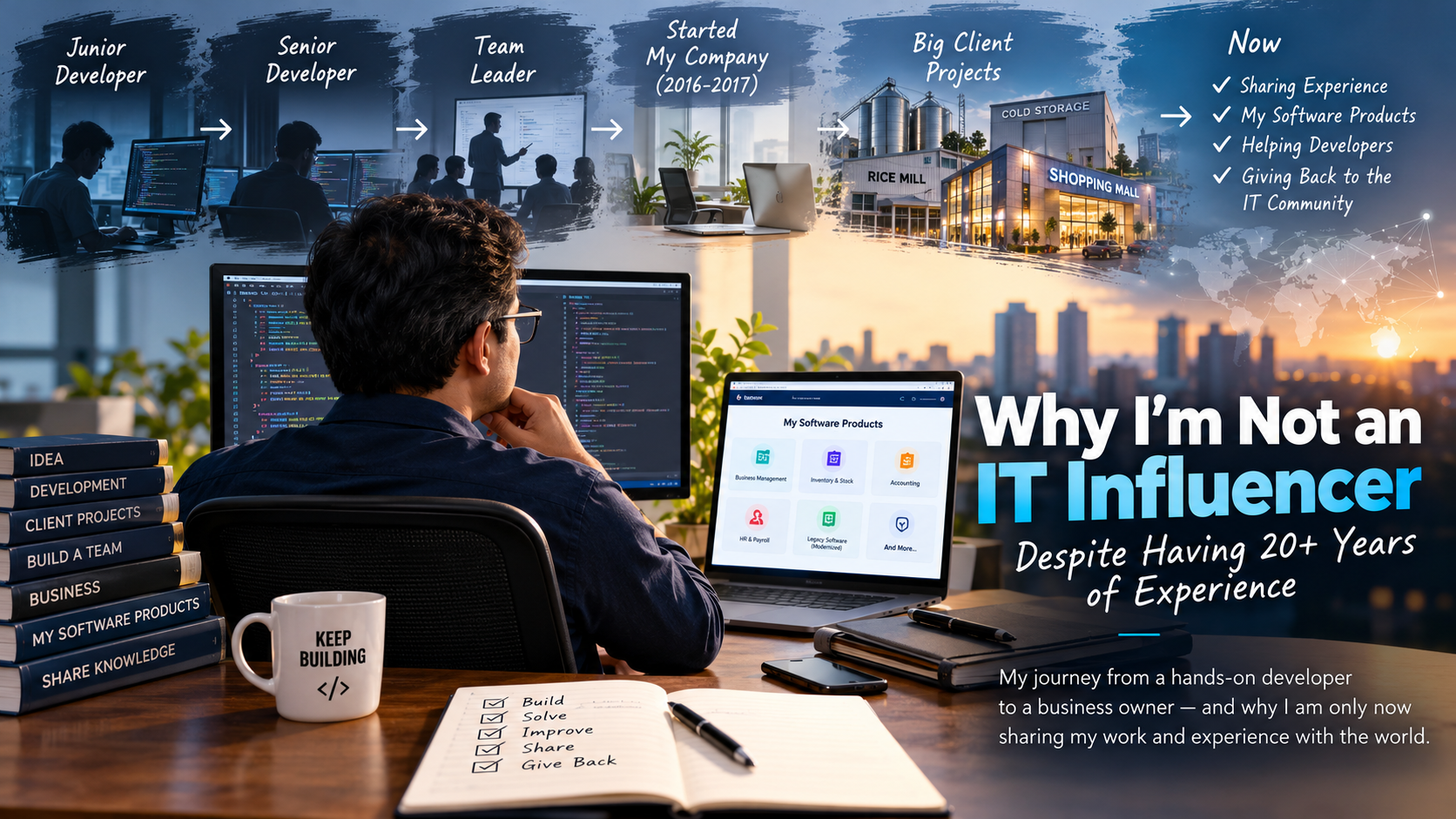
My journey from a hands-on software developer to a business owner, and why I am only now sharing my work and experience with the world.
Have you ever wondered why someone with more than 20 years of experience in the IT industry is not already a well-known name on social media?
Why would an experienced software developer, team leader, and business owner suddenly start posting about his work, sharing technical knowledge, and showcasing software products after so many years?
Is it because he has only recently started working in IT? Has he exaggerated his experience? Or has he simply never done anything worth talking about?
I understand why people might have these questions.
So, instead of making big claims about myself, I want to share my journey. I want to explain where I started, why I built my own company, what kept me away from social media for years, and why I have decided to become more active now.
This is not a story about becoming an influencer. It is a story about being a developer first, a business owner second, and someone who has finally decided to share what he has learned along the way.
My First 10 Years in the IT Industry
I have spent more than 20 years in the IT field, with approximately the first 10 years of my professional career spent working in the software industry.
During that time, I progressed through several roles, starting as a Junior Software Developer, moving on to Senior Software Developer, and eventually becoming a Team Leader.
Those years were an important part of my professional development. I worked on software projects, solved technical problems, collaborated with development teams, and learned how to translate business requirements into practical solutions.
My performance was consistently strong. The companies I worked for conducted quarterly assessments, and I regularly achieved Grade A, sometimes even Grade A+.
However, the recognition I valued most was not a grade or a designation. It was the trust I earned from clients.
Clients often preferred communicating directly with me because they knew I would make every effort to understand their requirements and deliver a complete solution. Within the teams I worked with, I had built a reputation for taking ownership of problems and finding practical ways to solve them.
That trust became one of the most valuable assets I carried into my entrepreneurial journey.
Why I Started My Own Company in 2016–2017
Despite gaining professional experience and progressing in my career, I eventually reached a point where I wanted something more.
I wanted greater independence. I wanted to build things on my own terms, take responsibility for complete projects, and create something that I could call my own.
That desire led me to establish my own company around 2016–2017.
Starting a company was not simply about leaving a job and becoming a business owner. It meant taking responsibility for clients, managing developers and designers, delivering projects, solving unexpected problems, and ensuring that the business could meet its commitments.
Fortunately, I did not have to start entirely from scratch when it came to finding clients.
Over the years, I had built professional relationships with clients from the companies where I had worked. Some knew me personally through our previous projects, while others had learned about my work through professional connections.
When some of these clients discovered that I had started my own company, they began referring new opportunities to me.
In one case, a client from my previous professional network referred someone he knew to my company. That referral became the beginning of a major business relationship.
It was an important reminder that the relationships we build through our work can sometimes become more valuable than any marketing campaign.
How One Client Changed the Direction of My Business
The client who came through that referral had a substantial business operation.
His business interests included cold storage facilities, rice mills, and other related enterprises. His business network also extended to shopping malls and associated commercial operations.
This was not a small project that could be completed in a few days.
The scale of the business meant that its software development and servicing requirements demanded considerable time, coordination, and responsibility.
As the person running my company, I was directly involved in managing the work. I had my own team of developers and designers, and a significant part of my day went into coordinating their work, reviewing requirements, addressing issues, communicating with the client, and making sure that everything moved in the right direction.
There were days when we worked until 10 PM, midnight, or sometimes even later.
And this was not just about completing the development phase.
Once the software was delivered, there was ongoing support, maintenance, troubleshooting, and additional work to handle. A major client relationship brings long-term responsibilities that do not disappear when a project goes live.
For approximately five to six years, this business kept me deeply involved in day-to-day project execution and client servicing.
My working life revolved around software, people, deadlines, and solving problems.
I was busy building and maintaining systems, not building an online audience.
Why I Stayed Away from Social Media for Years
People often assume that anyone running a software company should be actively marketing the business on every available platform.
But my situation was different.
I had secured substantial project work through professional relationships and referrals. The projects required extensive involvement, and the business did not depend on my becoming a social media personality to generate new leads.
Marketing on social media was simply not a priority.
To be honest, I neither had much time for it nor felt a strong desire to participate in it.
I was comfortable doing what I had always done: sitting in front of my computer, working on software, managing my team, and delivering solutions.
For years, my professional identity was built around actual development work and client relationships rather than public visibility.
I did not spend those years trying to build a personal brand. I spent them doing the work.
That explains why my social media presence may not reflect the length of my professional experience.
An absence of online visibility does not necessarily mean an absence of professional experience. Sometimes, it simply means that a person has been busy doing something else.
From Client Projects to Building My Own Software Products
Eventually, the major phase of that client engagement came to an end, and I found myself looking at the next stage of my professional journey.
I wanted to focus more seriously on my own software products and take my company in a new direction.
But there was a challenge.
Although I had developed numerous software applications and tools over the years, I had spent a considerable period concentrating on client work rather than actively developing and promoting my own product portfolio.
I needed time to bring that work together, revisit older projects, improve them, and prepare them for a modern audience.
That became a substantial undertaking in itself.
For more than two years, I devoted a significant amount of time to developing, refining, and preparing my software products.
These were not simply ideas that I had written down or concepts that existed only in presentations. They were applications built through actual software development work.
Many of the products in my portfolio originated from projects I had worked on much earlier in my career.
Some of my legacy software applications were originally developed between 2010 and 2014. They were built for the requirements, technologies, and design expectations of that period.
Over time, however, software development practices, user interface standards, and user expectations changed considerably.
I knew that simply presenting these older applications in their original form would not adequately reflect the standards I wanted to achieve today.
So I decided to revisit them.
Revamping My Legacy Software for a Modern Audience
A significant part of my current software portfolio consists of applications that I originally developed years ago.
These products had different interfaces, design approaches, and user experiences because they were created at different times.
Rather than abandoning them, I decided to bring them forward.
I revisited the existing code, reworked the applications, modernized their interfaces, and redesigned them to create a more consistent experience across the portfolio.
This process required more than changing colours or updating a few screens. It involved reviewing existing implementations, understanding how the applications worked, identifying areas for improvement, and adapting older software to modern expectations.
When AI-assisted development tools became available, I began using them as well.
I used AI to help refactor existing code, improve implementations, and accelerate parts of the modernization process. However, the original software development work behind these applications was mine and my team’s. AI became an additional tool in the development process, not a replacement for the work that had already been done.
I believe it is important to make that distinction.
There is a difference between generating an application from a new prompt and using modern tools to improve, refactor, and maintain software that you have already developed.
My current portfolio represents years of development experience combined with the effort required to bring older applications up to a more modern standard.
And getting these products ready was only one part of the job.
Building the Website Was Another Major Project
Once the products were ready, I needed a proper place to present them.
I wanted a website where people could explore my software, learn about what each product does, understand its potential applications, and discover the work behind my company.
Building that website took considerable time and effort.
It involved more than uploading product names and adding a few screenshots. I had to organize the portfolio, prepare product information, develop the necessary pages, and create a presentation that could make sense to visitors who had never worked with me before.
I also had to think about how to reach people beyond my existing professional network.
For years, referrals and established business relationships had played an important role in bringing work to my company. Now, I wanted to create opportunities for people around the world to discover my products independently.
That required a different mindset.
I was no longer thinking only about how to develop and deliver software. I was also thinking about how to present it, explain its value, reach the right audience, and build a sustainable presence in the market.
In other words, I needed to learn and apply the marketing side of the business more seriously.
Why I Am Becoming Active on Social Media Now
This brings me to the present.
I have started becoming more active on social media, developer communities, forums, and platforms such as DEV Community.
I am also working to submit and showcase my products through different channels so that more people can discover them.
My goal is to expand my company’s reach beyond the clients and professional contacts I have accumulated over the years.
I want people to discover my software, understand what I build, and have the opportunity to work with me.
At the same time, I want to share the knowledge I have accumulated throughout my career.
Over more than two decades, I have learned lessons about software development, debugging, project management, working with clients, building products, maintaining legacy systems, and running a software business.
I have made decisions, solved difficult problems, and experienced the realities of working in the IT industry.
There is a great deal that I can share with other developers, particularly those who are at an earlier stage of their careers or are thinking about building their own products and businesses.
I believe those experiences can be useful to someone else.
And I do not want everything I have learned to remain limited to my own projects and professional life.
I Want to Give Something Back to the IT Community
The IT industry has given me a great deal.
It has given me a career, professional experience, opportunities to solve meaningful problems, the ability to build software, and the confidence to establish my own company.
I have had the opportunity to work with clients, manage teams, develop applications, and turn technical ideas into practical solutions.
I am grateful for that journey.
Now, I want to give something back.
For me, sharing knowledge is one way to do that.
I want to discuss what I have learned, share practical insights from real development work, explain the thinking behind software products, and help other developers understand aspects of the industry that are not always covered in tutorials or theoretical discussions.
I also want to share my own products and the lessons I learn while building and marketing them.
I am not suggesting that I know everything. The technology industry changes constantly, and there is always something new to learn.
But I believe that experience has value when it is shared honestly and constructively.
If something I have learned over the past 20 years helps another developer solve a problem, avoid a mistake, or approach a project more effectively, then sharing that experience is worthwhile.
That is one of the reasons I have decided to become more visible online.
I Have Always Been a Hands-On Developer
There is one thing I want people to understand about me.
I have always been a hands-on developer.
For much of my professional life, I spent long working hours in front of a computer, concentrating on the work that needed to be done. I was not particularly interested in talking about myself or promoting my achievements.
I preferred writing code, solving problems, improving applications, and making sure that the work was completed.
I was never someone who spent years cultivating an online persona while leaving the actual development to someone else.
My experience comes from being involved in the work itself.
That does not mean marketing, communication, or personal branding are unimportant. I now understand that they are essential if you want to grow a product business and reach people beyond your existing network.
But these are areas I have started focusing on more seriously only in recent years.
So, when you see me posting on social media today, you are not seeing someone who has spent 20 years building an influencer career.
You are seeing a software developer who has spent years building applications, working with clients, managing projects, and running a company—and who is now learning to communicate that experience to a wider audience.
There is a difference.
You Do Not Need to Be an Influencer to Have Real Experience
We live in a time when online visibility can easily become a measure of credibility.
People see followers, engagement, video views, and personal branding. These things can be useful indicators of reach, but they do not tell the whole story of someone’s professional life.
A developer may have thousands of followers without having built a substantial software product.
Another developer may have spent years building complex applications, managing teams, and solving business problems without ever developing a significant online presence.
Neither social media popularity nor the absence of it tells the complete story.
I am not saying that an online audience is meaningless. I am working to build my own presence because I recognize its value.
But I also believe that professional experience should be understood in context.
My career did not begin when I created my website or started publishing posts.
My software development journey began decades ago.
The website, the product portfolio, and my recent activity on developer platforms are simply the next chapter of that journey.
And I am happy to share it.
What You Can Expect From Me Going Forward
As I continue developing my company and expanding the reach of my products, I plan to share more of my work and experience.
You can expect practical discussions about software development, lessons from building and maintaining applications, insights into legacy software modernization, and experiences from running a software business.
I also intend to showcase the products I have developed and explain the problems they are designed to solve.
Some of my posts will be technical. Others will focus on entrepreneurship, product development, marketing, and the realities of building software independently.
I will continue learning, experimenting, and improving along the way.
I do not expect to become an influencer overnight, and that is not the point.
My goal is to build a meaningful professional presence that reflects the work I actually do.
I would rather share useful knowledge consistently than try to appear successful through exaggerated claims.
Final Thoughts: I Built Software Before I Built an Online Presence
If you have recently discovered me and wondered why someone with more than 20 years of IT experience is only now becoming active online, I hope this article answers your question.
For years, my time was devoted to software development, client projects, team management, and maintaining business relationships. Later, I spent years focusing on my own software portfolio, modernizing applications, and preparing my website and products for a wider audience.
Social media was not the centre of my professional life.
Building software was.
Now, I am entering a different phase—one in which I want to share my work, connect with the global developer community, reach new customers, and pass on some of the knowledge I have gained throughout my career.
I am not here to pretend that I have already mastered online marketing or built a massive audience.
I am here because I have work to show, experience to share, products to develop, and more to learn.
I spent years building software before I started building my online presence. Now, I want the world to see what I have been working on.
That is my story.
And this is only the beginning.
About the Author
Debasis Bhattacharjee is a software developer, software architect, and entrepreneur with more than 20 years of experience in the IT industry. His professional journey spans software development, team leadership, client project delivery, and building his own software business. He is currently focused on developing and modernizing software products, expanding their reach to a global audience, and sharing practical knowledge with the developer community.
Visit my website to explore my work, software products, and more: DebasisBhattacharjee.com.