Overview
Super Pi Mod XS is a single-threaded, arbitrary-precision Pi calculator used purely as a classic CPU speed benchmark. It calculates the digits of Pi to a size you choose and reports how long the calculation took — a smaller elapsed time means faster raw single-core performance. This exact style of benchmark has been used to compare CPUs since the early 2000s, precisely because computing Pi to a large digit count is computationally intensive, deterministic, and produces a single, directly comparable number: seconds elapsed for a given digit count.
Unlike the multi-threaded benchmarks elsewhere in this category, Super Pi Mod XS deliberately uses only one thread, making it a pure test of single-core performance — the metric that still matters enormously for anything that cannot be parallelized, from many games to everyday application responsiveness.
Key Features
- Three selectable digit-count presets for quick, standard or extended runs
- Purely single-threaded — an honest measure of one core's raw calculation speed
- Reports precise elapsed time to three decimal places for fine-grained comparison
- Uses arbitrary-precision arithmetic, not floating point, avoiding any rounding-related shortcuts
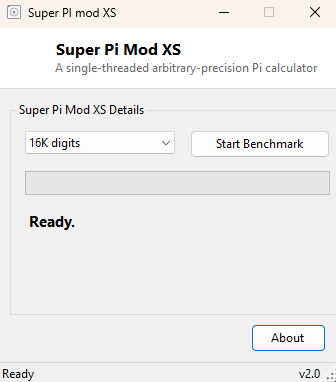
- Simple one-button interface with a progress indicator during calculation
Why You Might Need This Tool
Single-threaded performance benchmarks remain genuinely useful even in a multi-core world, because a great deal of real software — including large parts of most games, scripting engines, and everyday UI responsiveness — is still bottlenecked by how fast one core can execute serial work, not by how many cores are available. Running this benchmark before and after a CPU upgrade, an overclock, or a BIOS/motherboard change gives you a directly comparable number to confirm whether the change actually helped. It is also a handy quick sanity check that a system is performing normally after reinstalling Windows or changing power plan settings that might silently be throttling clock speeds.
How It Works
The calculation uses Machin's formula — π/4 = 4·arctan(1/5) − arctan(1/239) — computed
with .NET's System.Numerics.BigInteger type scaled to the requested
precision rather than standard floating-point math, which would lose precision long
before reaching the requested digit count. Each arctangent term is evaluated as a
convergent integer series, accumulating terms until they become smaller than the
working precision allows, entirely on a single background thread so the UI stays
responsive while a Stopwatch times the whole operation from start to
finish. The three presets (roughly 16K, 64K and 256K digits) trade calculation time
for benchmark sensitivity — the larger digit counts take longer but more clearly
separate CPUs of similar performance.
How to Use It
Choose a digit-count preset from the dropdown, then click Start. A marquee progress indicator shows the calculation is running; on modern hardware the smallest preset typically finishes in well under a second, while the largest can take several seconds depending on the CPU. When the calculation completes, the result line reports the digit count and the precise elapsed time — that elapsed time is the number to record and compare across runs, machines or configurations.
System Requirements & Notes
Runs on 64-bit Windows 10 and Windows 11 and does not require administrator privileges. Close other CPU-intensive background applications before running a benchmark comparison for consistent, repeatable results, since this tool measures wall-clock elapsed time rather than isolating CPU cycles specifically consumed by its own thread.
Frequently Asked Questions
Why does it only use one CPU core?
That is intentional — this benchmark specifically measures single-core performance.
For a multi-threaded benchmark that scales across every core, see
wPrime in the same category.
Can I compare results against other Super Pi variants?
Results are only directly comparable between runs of this same tool at the same digit
preset, since different implementations use different algorithms and precision
strategies with different absolute timings.
Does a faster result always mean a better CPU?
For single-threaded workloads, yes, broadly — but remember it says nothing about
multi-core throughput, memory bandwidth, or storage speed, all of which matter for
overall system performance.