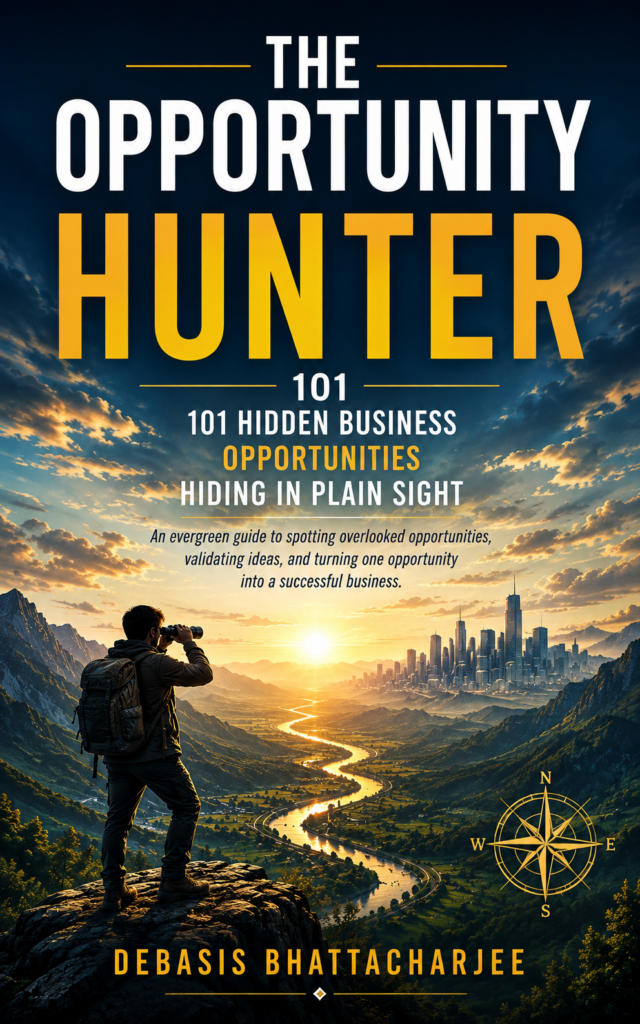
The Opportunity Hunter
101 hidden business opportunities hiding in plain sight — and the framework for turning one into your first validated offer.
101 hidden business opportunities hiding in plain sight — a practical framework for spotting overlooked ideas and turning one into a validated first offer.
Introduction: Everyone Is Looking, Almost No One Is Seeing
The Opportunity Hunter is built on a simple observation: most people scan their surroundings for opportunity constantly, yet almost no one actually sees it. Good business ideas are not rare — they are simply unnoticed, hiding inside everyday frustrations, underserved niches, emerging shifts, and gaps inside other people’s businesses. This book trains the reader to notice what is already there, then walks them, step by step, from noticing to a validated first offer.
Maybe you’ve circled the same “what business should I start” question for months without landing anywhere. Maybe you’ve got a notebook full of half-ideas you never tested. Maybe you’re not even looking for a business yet, just curious whether the opportunities everyone talks about are real or already gone. This book meets you wherever you are and gives you a repeatable way to find, evaluate, and act on the opportunity that’s already around you.
The Opportunity Hunter’s Framework
At the center of the book is a framework built on four signals that separate a real opportunity from a false one, and seven recurring “hunting grounds” where opportunities tend to hide: everyday frustrations, underserved markets and niches, emerging shifts and trends, gaps inside other people’s businesses, time/convenience/outsourcing, local and community life, and skills/knowledge/content. Each hunting ground is paired with a worked, real-world spotlight example — a subscription auditing service, senior-friendly tech coaching, digital estate planning, fractional bookkeeping, home organizing, local ride coordination for seniors, and templates and swipe files — so every idea in the book is shown applied, not left abstract.
From Idea to Validated Offer
Spotting an opportunity is only half the book. The second half moves the reader from idea to action: a four-step validation process (talk to ten real people, find the money already in motion, build the smallest possible test, price it before you build it), realistic earning expectations by opportunity type, a process for turning one idea into a first real offer, and a chapter on stacking hunting grounds together for stronger, more defensible ideas. It closes by directly answering the doubts that stop people before they start, cataloguing the mistakes that quietly kill good opportunities, and laying out a concrete first-seven-days action plan.
Chapter-by-Chapter Breakdown
- Everyone Is Looking, Almost No One Is Seeing — Why opportunity is abundant, not scarce, and why almost nobody notices it anyway.
- The Opportunity Hunter’s Framework — The four signals of a real opportunity, and the seven places opportunities like to hide.
- Hunting Ground 1: Everyday Frustrations — Spotlight: the subscription auditing service.
- Hunting Ground 2: Underserved Markets and Niches — Spotlight: senior-friendly tech coaching.
- Hunting Ground 3: Emerging Shifts and Trends — Spotlight: digital estate planning.
- Hunting Ground 4: Gaps Inside Other People’s Businesses — Spotlight: fractional bookkeeping for solo businesses.
- Hunting Ground 5: Time, Convenience, and Outsourcing — Spotlight: home organizing and decluttering.
- Hunting Ground 6: Local and Community Life — Spotlight: local ride coordination for seniors.
- Hunting Ground 7: Skills, Knowledge, and Content — Spotlight: templates and swipe files.
- From Idea to Validated Opportunity — A four-step process: talk to ten real people, find the money already in motion, build the smallest possible test, price it before you build it.
- What These Opportunities Can Realistically Earn — Realistic income expectations across service, niche/local, and knowledge/content ideas.
- Turning One Idea Into Your First Real Offer — Naming the customer, stating the outcome, and making the first yes small.
- Stacking Hunting Grounds for a Stronger Idea — Combining hunting grounds (e.g. local plus skills, niche plus convenience) for harder-to-copy ideas.
- Answering the Doubts That Stop People Before They Start — Direct answers to “I don’t have enough money,” “what if someone copies my idea,” and five more common fears.
- Mistakes That Quietly Kill Good Opportunities — Falling in love before testing, chasing a market instead of a problem, and five more traps.
- Your First Seven Days — A concrete, day-by-day action plan to start hunting immediately.
Key Insight: Opportunity Is a Perception Problem, Not a Supply Problem
The book’s central argument is that most people don’t fail to find opportunity because it’s scarce — they fail because they haven’t trained themselves to see it. Once the four signals and seven hunting grounds become a habit of attention rather than a one-time exercise, opportunity stops feeling rare and starts feeling constant. The rest is simply validating fast, pricing honestly, and making the first offer small enough to say yes to.
“Opportunity was never hiding from you. You were just looking past it.”
Who Should Read This Book
- Aspiring entrepreneurs stuck at “I don’t know what business to start.”
- Side-hustlers looking for their first validated idea, not their tenth unvalidated one.
- Freelancers and consultants who want to package what they already know into an offer.
- Anyone who has ever thought “all the good ideas are already taken” and wants a framework to prove that wrong.
About the Author
Debasis Bhattacharjee is a software entrepreneur, technology strategist, product architect, and the driving force behind Debmedia Technologies LLP.
For years, he has been working at the intersection of software, technology, entrepreneurship, artificial intelligence, SaaS, automation, and digital products—not simply studying these subjects, but turning ideas into working products and real-world solutions.
His journey has been deeply product-driven. From desktop and Windows software to web applications, enterprise solutions, SaaS platforms, AI-powered products, automation systems, utilities, and digital products, Debasis has spent years exploring one fundamental question: how can technology be transformed from an idea into something useful, valuable, and commercially viable?
That philosophy has led him to build and experiment with a large portfolio of software and digital products, while continuously exploring new opportunities created by emerging technologies and changing markets. But technology is only one side of his work — he is equally fascinated by the business behind the product: finding problems worth solving, identifying opportunities others overlook, understanding what people actually need, designing compelling products, creating practical offers, and turning technical capabilities into businesses.
Through his books, he aims to make complex ideas practical — frameworks, mental models, and strategies readers can understand, adapt, and apply, rather than theory for its own sake.
You've Scrolled This Far
for a Reason.
Maybe you want to work together. Maybe you want to discuss something you read. Either way — the conversation costs nothing.
hello@debasisbhattacharjee.com · Mon–Fri, 9AM–6PM IST