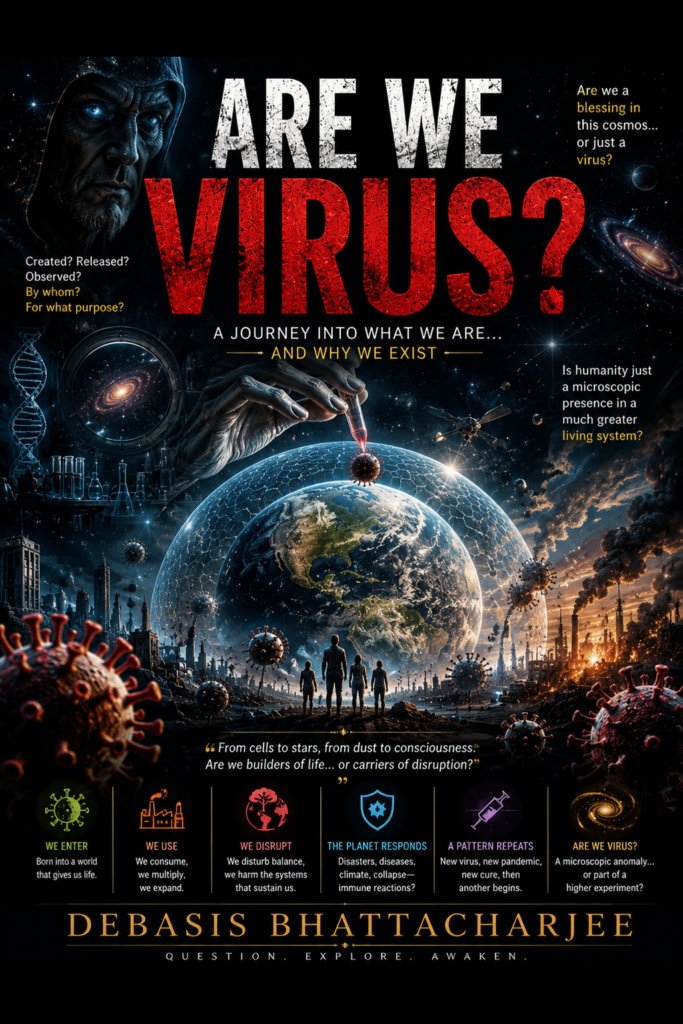
Are We Virus?
A cosmic thought experiment: if a virus could never perceive the intelligence behind an immune response, what makes us certain we would recognize one from the planet or the cosmos we inhabit?
A cosmic thought experiment: if a virus could never perceive the intelligence behind an immune response, what makes us certain we would recognize one from the planet or the cosmos we inhabit?
Introduction: A Question That Never Left
Are We Virus? A Cosmic Thought Experiment on Humanity, Consciousness, and Our Place in the Universe opens with an unusually candid disclaimer: the author admits he doesn’t feel like the full, conscious author of what follows — the ideas arrived through him faster and stranger than his ordinary thinking, connecting physics, biology, ancient wisdom, and cosmic patterns without deliberate effort. Whatever the actual source, the book is offered explicitly as a series of open questions, not conclusions: “Could it be that…?” rather than “this is the truth.”
Its central thought experiment is simple to state and hard to shake: viruses are roughly a trillion times smaller than the human body, and humans are roughly a trillion times smaller than the solar system. If a virus, given sudden awareness, could never comprehend the immune system responding to it as a purposeful, intelligent reaction — only as unexplained obstacles — what makes us certain we’d recognize the same kind of response, at our own scale, from the planet or the cosmos we inhabit?
What You’ll Explore
The book moves outward and inward at once — from the near-incomprehensible scale of galaxies down to the 380 trillion viruses estimated to exist in a single human body right now, using that dizzying range to reframe humanity’s relationship with Earth through the lens of a virus’s relationship with its host. From there it opens into nested-universe cosmology, the possibility of the universe itself breathing in cycles, nested nested-universe recursion, and a direct, unflinching question the book keeps circling back to: are climate change, pandemics, and disasters better understood as pure physical accident, or as something closer to a systemic immune response to our presence?
Chapter-by-Chapter Breakdown
- How Small Are We, Really? — The scale of galaxies, cells, and viruses, and why our “middle position” between the microscopic and the cosmic might not be a random fact.
- The Virus Metaphor: Beautiful or Dangerous? — Taking the comparison seriously while questioning its limits and its risks.
- Nested Universes: Inside a Cell, Inside a God — What it would mean if scale itself were recursive, layer within layer.
- The Breath of the Universe — Cosmic expansion and contraction read as a living rhythm rather than pure mechanics.
- Why Are We Here? — The thought experiment’s most direct confrontation with purpose and meaning.
- The Infinite Loop: Universe Within Universe — Pushing the nested-scale idea to its logical, vertiginous conclusion.
- Cosmic Correction: Are We Being Treated? — Reading planetary and cosmic events as a possible corrective response, the way a fever responds to infection.
- The Balance of Existence — Harmony and discord as a tuning mechanism running through consciousness itself.
- The Two Invisible Microphones — A distinct framework for how signal and response might travel between scales we can’t directly perceive.
- Viral Variations — Different modes of the same core pattern, examined from multiple angles.
- Final Chapter — The Cosmic Judgment: Are We the Disease… or the Organ? — The book’s closing turn toward Sanatan Dharma, and the possibility that this ancient tradition already contains the answer to whatever we turn out to be.
“Just as a virus cannot understand the awareness of the body it lives in, perhaps we cannot perceive the unified nature of the systems we live in.”
Who Should Read This Book
- Readers of speculative, science-adjacent philosophy who enjoy a thought experiment pushed all the way to its uncomfortable edges.
- Anyone drawn to cosmology and scale — from the size of galaxies down to the trillions of viruses in a single human body.
- Readers interested in Sanatan Dharma and Vedic cosmology, which the book turns to directly in its closing chapter.
- Fans of the author’s other titles — Adi Shakti: The Primordial Energy and Darkness: The Fundamental Reality — looking for another entry in the same science-meets-cosmology vein.
About the Author
Debasis Bhattacharjee is an author, filmmaker, technologist, and independent thinker whose work moves between modern science and technology on one side and spirituality, philosophy, and ancient knowledge on the other. He does not present speculative ideas as settled fact — this book in particular is offered as a set of open questions rather than conclusions, drawing connections across physics, biology, and ancient wisdom traditions and inviting readers to follow the thread themselves, keeping what resonates and setting aside what doesn’t.
You've Scrolled This Far
for a Reason.
Maybe you want to work together. Maybe you want to discuss something you read. Either way — the conversation costs nothing.
hello@debasisbhattacharjee.com · Mon–Fri, 9AM–6PM IST