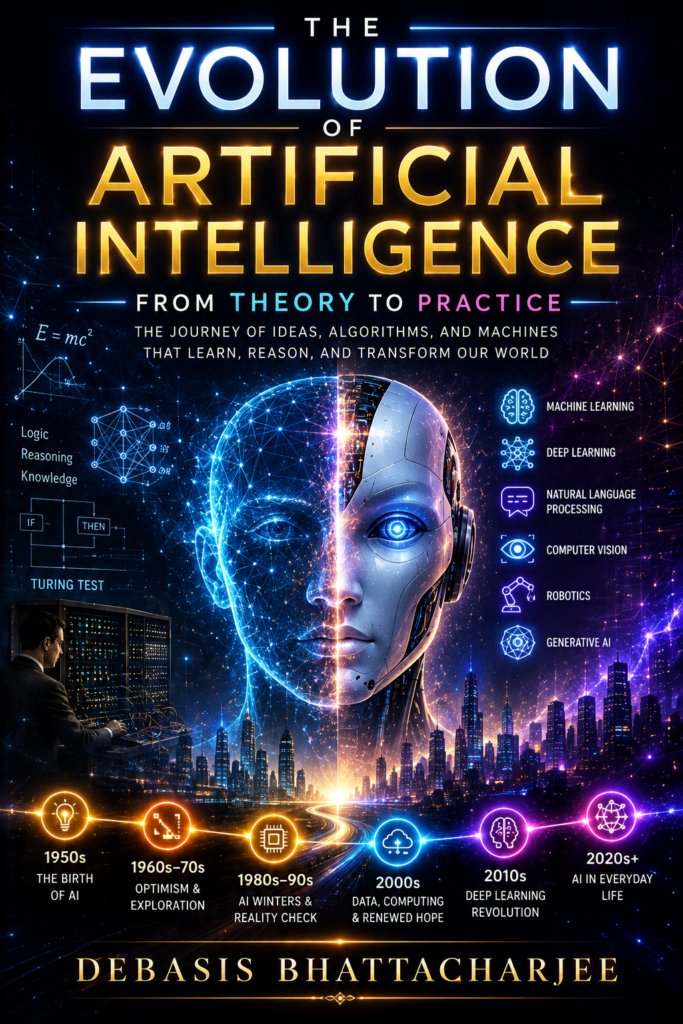
The Evolution of Artificial Intelligence: From Theory to Practice
A chronological, historically-grounded account of AI from its 1940s theoretical foundations through todays large language models — covering both AI winters, real-world deployment, and the ethics shaping the field now.
A chronological, historically-grounded account of AI from the 1940s theoretical foundations through todays large language models — covering both AI winters, real-world deployment, and the ethical questions shaping the field now.
Introduction: Seven Decades of a Single Question
The Evolution of Artificial Intelligence: From Theory to Practice traces AI’s full arc — from the theoretical foundations laid down in the 1940s to the large language models and generative systems reshaping daily life today. Rather than treating AI as a sudden 2020s phenomenon, this book makes the case that today’s breakthroughs are the latest chapter in a seven-decade story marked by extraordinary optimism, sobering setbacks, and hard-won progress. It examines not just the technical milestones, but the human stories, institutional challenges, and societal implications that shaped AI’s development at every stage.
Where a beginner’s guide explains what AI does, this book explains how it got here — and argues that understanding the field’s history, including its two “AI winters,” is essential context for navigating whatever comes next.
Why History Matters for Understanding AI Today
Modern AI discourse tends to treat every new capability as unprecedented. This book pushes back on that framing by showing how directly today’s large language models, computer vision systems, and reinforcement-learning breakthroughs descend from ideas first proposed by Alan Turing, Warren McCulloch, and the organizers of the 1956 Dartmouth Conference. It also takes seriously the field’s failures — the First AI Winter of the 1970s and the funding collapse that followed inflated 1960s promises — as essential lessons for evaluating the claims made about AI today.
What You’ll Learn
The book moves chronologically through AI’s theoretical foundations, its first wave of symbolic reasoning and expert systems, the AI winter that followed, the neural network renaissance, the deep learning revolution, and the modern era of transformer architectures and generative AI. It then shifts from history to application, covering AI in healthcare, autonomous vehicles, finance, manufacturing, and education, before closing with a clear-eyed look at bias, privacy, job displacement, and AI safety — the ethical questions that now shape the field as much as the technology itself.
Chapter-by-Chapter Breakdown
- Introduction to Artificial Intelligence — Defining AI, the spectrum from Narrow AI to Superintelligence, and the vision of machine intelligence from Turing onward.
- Theoretical Foundations (1940s–1950s) — The birth of computing and cybernetics, Turing’s vision of thinking machines, and the Dartmouth Conference that named the field.
- The First Wave — Logic and reasoning systems, early AI programs, expert systems, and the promise and limitations of symbolic approaches.
- The AI Winter and Renewed Hope (1970s–1980s) — Why funding and confidence collapsed, the rise of commercial expert systems, and the lessons the field carried forward.
- The Second Wave — The neural network renaissance, statistical learning, and how the early internet era gave AI the data it had always lacked.
- The Deep Learning Revolution (2000s–2010s) — The computational breakthrough, convolutional networks and computer vision, and the early advances in natural language processing.
- Modern AI Landscape (2010s–Present) — Large language models and transformer architecture, generative AI, reinforcement learning, and multi-modal systems.
- AI in Practice — Real deployment across healthcare and medical diagnosis, autonomous vehicles, finance and trading, manufacturing, and personalized education.
- Ethical Considerations and Societal Impact — Bias and fairness, privacy and data protection, job displacement, and the emerging discipline of AI safety and alignment.
- The Future of Artificial Intelligence — Emerging trends, the prospects for artificial general intelligence, human-AI collaboration, and how to prepare for what’s next.
The book closes with a full Conclusion, an extensive Bibliography organized by era and topic (from foundational texts through contemporary AI research), and an Index — giving it the structure of a genuine reference work rather than a quick read.
Key Insight: Progress Was Never a Straight Line
Perhaps the book’s most useful contribution is refusing to present AI’s progress as inevitable. Each wave of enthusiasm — the 1950s optimism that human-level AI was a decade away, the 1980s expert-systems boom, the promises made about every subsequent breakthrough — was followed by a reckoning where the technology’s real limitations became clear. The book argues that today’s generative AI boom deserves the same historically-informed scrutiny: real and significant, but part of a pattern, not an exception to it.
Who Should Read This Book
- Professionals and students who want a serious, structured understanding of how AI actually developed, not just what it can do today.
- Business and technology leaders evaluating AI claims, who want historical context for separating durable progress from hype cycles.
- Anyone who has read a beginner’s AI guide and wants the deeper, more comprehensive follow-up — this book assumes curiosity, not prior technical training.
- Readers interested in AI ethics and policy, thanks to its dedicated treatment of bias, privacy, job displacement, and AI safety.
About the Author
Debasis Bhattacharjee is a software engineer, technology architect, educator, and independent author with more than two decades of experience in Information Technology, holding academic backgrounds in Computer Science at both the B.Tech and M.Tech levels. His work has spanned software development, system architecture, technology products, digital platforms, and business-oriented software solutions, alongside years of teaching and mentoring students in Computer Science and Engineering. His approach to technical writing is deliberately practical: connecting technological concepts to real-world applications, problems, and human behavior, so readers come away able to reason about AI’s trajectory rather than simply memorize its milestones.
You've Scrolled This Far
for a Reason.
Maybe you want to work together. Maybe you want to discuss something you read. Either way — the conversation costs nothing.
hello@debasisbhattacharjee.com · Mon–Fri, 9AM–6PM IST