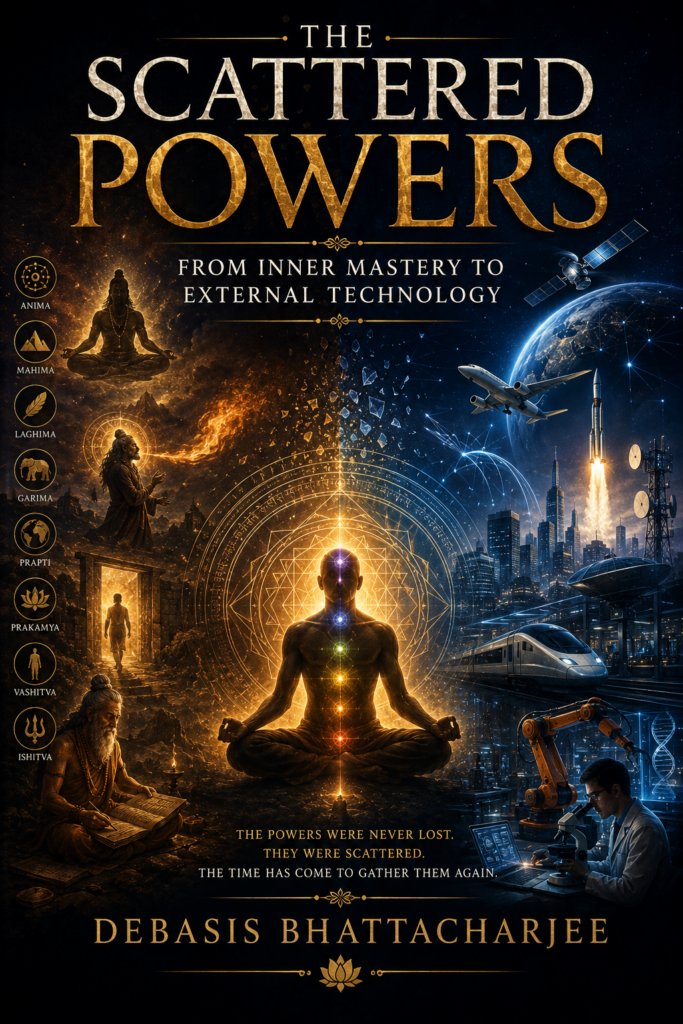
The Scattered Powers: From Inner Mastery to External Technology
A cross-cultural argument that every modern technology mirrors an inner ability ancient traditions once claimed to develop through consciousness practice — and what integrating both paths could mean for the next phase of human development.
A cross-cultural argument that every modern technology mirrors an inner ability ancient traditions once claimed to develop through consciousness practice — and what integrating both paths could mean for the next phase of human development.
Introduction: The Great Scattering
The Scattered Powers: From Inner Mastery to External Technology opens with a radical proposition: human evolution has followed two distinct paths. The first, pursued by ancient traditions, led inward — developing extraordinary capabilities through consciousness, breath, and spiritual practice. The second, which defines the modern era, led outward — building technologies that duplicate and often surpass those same abilities, but at the cost of fragmenting an inherent human wholeness. Every technology we’ve built, the book argues, seems to mirror an ability ancient texts already described: we spoke of projecting consciousness across distances, then built the telephone and the internet; we described flying, then built airplanes; we claimed mastery over the elements, then built chemistry and nuclear power.
This is not an anti-technology book, and it says so directly — it is not a call to abandon modern achievement or romanticize the past. It’s an invitation to ask whether the next phase of human development might mean gathering the scattered powers back together: combining the inner mastery of our ancestors with the outer achievements of the present, rather than treating them as a trade-off we already lost.
What You’ll Learn
The book opens by documenting the historical record: Tibetan lung-gom practitioners covering vast distances on foot, Amazonian shamans describing verifiable information gathered through consciousness practices, Greek and Roman accounts of bi-location, and Christian mystics like Saint Teresa of Ávila reporting involuntary levitation during prayer. It then turns to the most systematic source on the subject — the Hindu tradition of the eight classical siddhis — before tracing, domain by domain, how each inner capability was externalized into a modern technology: walking on water, flying through air, controlling the elements, and manipulating weight.
What’s Inside
- The Forgotten Powers — Cross-cultural historical accounts, from Tibetan lung-gom to Christian mystical levitation.
- The Hindu Siddhis — The eight classical powers described in Hindu tradition, and their systematic internal logic.
- The Inner Laboratories — How contemplative traditions actually trained and verified these capabilities.
- The Moment of Scattering and The First Externalizations — The historical hinge point where inward development began giving way to outward invention.
- The Modern Manifestations — Four deep-dive chapters: Walking on Water, Flying Through Air, Controlling Elements, and The Weight Manipulators — each pairing an ancient claimed ability with its modern technological equivalent.
- The Current State — What We’ve Gained, What We’ve Lost, and The Hidden Costs of trading inner capability for external infrastructure.
- The Future Integration — Reclaiming the Inner Path, The Next Evolution, and Towards Whole Humans: a concrete vision for integrating both paths rather than choosing between them.
- The Gathering — A closing synthesis, followed by appendices for further study.
Key Insight: Every Gain Has a Shadow Cost
The book’s most useful discipline is refusing to treat technological progress as a costless win. For every capability externalized — the shaman’s long-distance communion replaced by satellite communication, the yogi’s temperature regulation replaced by climate control, the mystic’s claimed transmutation replaced by industrial chemistry — it asks what was actually lost in the trade: dependency on systems we don’t understand, disconnection from the natural world, and a kind of learned powerlessness even as our collective capabilities exploded. The book’s closing argument is that “whole humans” won’t be found by rejecting technology, but by deliberately redeveloping the inner capacities alongside it.
“The powers were never truly lost — they were transformed, scattered, and externalized. The question now is whether we can gather them again, not in the fragments of our devices and systems, but in the wholeness of human beings who have learned to master both the inner and outer worlds.”
Who Should Read This Book
- Readers interested in meditation, siddhis, and contemplative traditions, wanting a systematic rather than anecdotal treatment.
- Technology professionals and futurists curious about a genuinely different framework for thinking about what technology replaces in us, not just what it gives us.
- Students of comparative religion and mysticism, given its wide cross-cultural sourcing from Tibetan, Amazonian, Greek, Roman, and Christian traditions.
- Readers of the author’s other titles in this vein, such as Adi Shakti: The Primordial Energy, who want the same science-meets-tradition approach applied to human capability itself.
About the Author
Debasis Bhattacharjee is an author, filmmaker, technologist, and independent thinker whose work moves between modern science and technology on one side and spirituality, philosophy, and ancient knowledge on the other. He does not present ancient claims as settled fact; instead, his books explore where contemplative traditions and modern technological achievement appear to be reaching for the same underlying human capabilities, and invite readers to investigate that pattern for themselves. His perspective is shaped directly by his own work as a technology professional, giving him an unusually literal vantage point for a book arguing that our machines are, in a real sense, externalized versions of powers older traditions once claimed to develop from within.
You've Scrolled This Far
for a Reason.
Maybe you want to work together. Maybe you want to discuss something you read. Either way — the conversation costs nothing.
hello@debasisbhattacharjee.com · Mon–Fri, 9AM–6PM IST