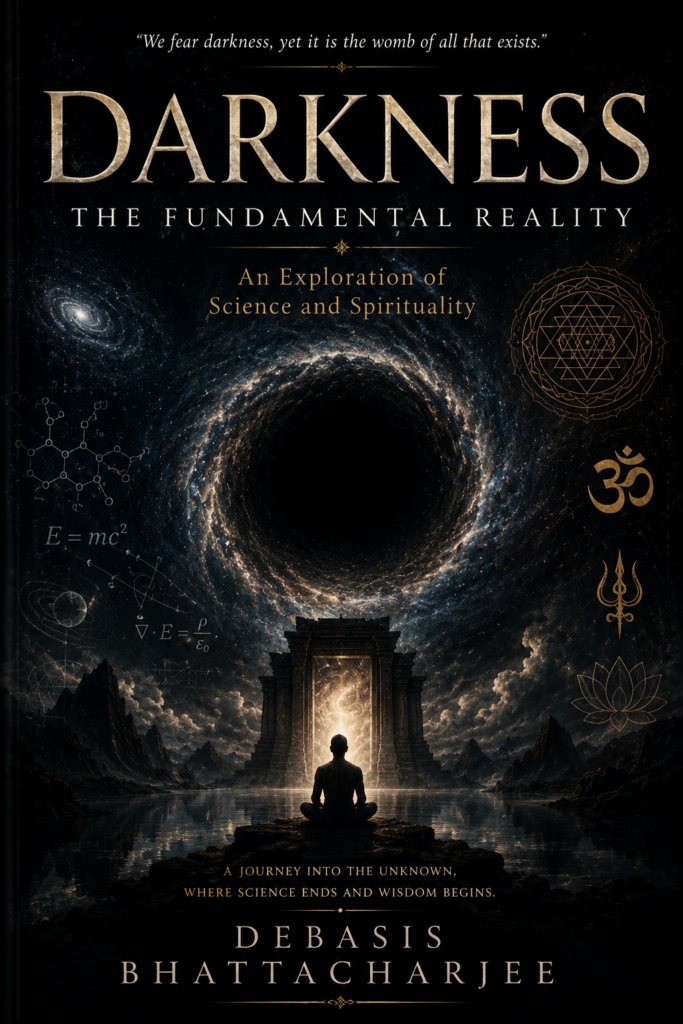
Darkness: The Fundamental Reality
A four-part exploration arguing darkness, not light, is the universes default state — mapping modern physics directly against Hindu philosophys Tamas, Maya, and the Gunas, then turning practical on living through lifes darker seasons.
A four-part exploration arguing darkness, not light, is the universes default state — mapping modern physics directly against Hindu philosophys Tamas, Maya, and the Gunas, then turning practical on living through lifes darker seasons.
Introduction: The Most Misunderstood Phenomenon in the Universe
Darkness: The Fundamental Reality makes an argument most readers will find genuinely disorienting at first: darkness, not light, is the default state of the universe — and light is the rare, temporary exception. Roughly 95% of the cosmos is composed of dark matter and dark energy, most of the universe’s volume is far from any star, and even the light that does exist eventually fades into the heat death of expanding, cooling space. From this cosmological starting point, the book builds an extended, carefully structured exploration of darkness as a physical, philosophical, and psychological reality — not the absence of something good, but a fundamental condition worth understanding on its own terms.
What makes the book distinctive is its structure: it treats modern physics and Hindu philosophy as two independent languages describing the same underlying territory, and spends its middle chapters showing, concept by concept, where they converge — the quantum vacuum and Brahman, virtual particles and Maya’s dance, zero-point energy and the Guna called Tamas, quantum fields and Akasha.
How the Book Is Organized
The book unfolds in four parts. It opens by establishing what darkness actually is at the physical level — the electromagnetic spectrum as our tiny visible window, the thermodynamics and quantum field theory of empty space, and the cosmic scale at which darkness dominates. It then turns to Hindu philosophy’s own deep vocabulary for these same ideas: Tamas as one of the three Gunas, Maya as the veil of illusion, and the creation myths across traditions that describe existence emerging from a primordial dark. Part III is the convergence — a direct, chapter-by-chapter mapping between quantum physics concepts and their philosophical counterparts. Part IV turns entirely practical: living with darkness in the ordinary, difficult sense — depression, grief, illness, the “dark night of the soul” — reframed not as pure suffering to escape but as a teacher with its own logic.
What’s Inside
- What Is Darkness, Really? — The photon’s journey through infinity, the electromagnetic spectrum as a tiny visible window, and darkness as information space.
- The Cosmic Truth — The mathematics of cosmic darkness, the expanding universe, the cosmic microwave background, and the coming heat death of the universe.
- The Asymmetry of Light and Darkness — The second law of thermodynamics as the universe’s only fixed direction, and why we remember yesterday but not tomorrow.
- The Quantum Darkness — The quantum vacuum, virtual particles, the observer effect, quantum entanglement, and the holographic principle.
- Tamas — Darkness in Hindu philosophy: the three Gunas, Tamas as the ground of being, and its widely misunderstood role in the dance of creation.
- Maya and the Veil of Illusion — Light as “the great deceiver,” the three states of consciousness, and the fourth state, Turiya.
- Creation Myths and Cosmic Darkness — Cross-cultural creation stories, the Vedic parallel to modern cosmology, and the Cosmic Dance of Shiva.
- The Divine Dark — Kali as the Dark Mother, the divine feminine as darkness, and the dark deities as mirrors for self-recognition.
- The Void That Creates — The direct convergence chapters mapping the quantum vacuum to Brahman, virtual particles to Maya, and dark energy to expanding awareness.
- Consciousness and Darkness — The paradox of self-inquiry, dreams and the dark source, and the space between thoughts.
- The Ecology of Light and Dark — Circadian darkness, light pollution as a form of spiritual pollution, and sleep as spiritual practice.
- Embracing the Dark — The dark night of the soul, depression and grief reframed, illness as inner teacher, and death as the great teacher.
“त्सि् — ‘That is the Truth.’ Everything ends in darkness — and darkness is where everything begins again.”
Who Should Read This Book
- Readers drawn to the science-meets-spirituality genre who want the physics taken seriously, not used as decoration for spiritual claims.
- Students of Hindu philosophy interested in a modern re-reading of Tamas, Maya, and the Gunas alongside contemporary physics.
- Anyone moving through a genuinely dark period — grief, illness, depression, uncertainty — looking for a framework that treats darkness as meaningful rather than simply something to escape.
- Readers who enjoyed the author’s other science-and-spirituality titles, such as Adi Shakti: The Primordial Energy, and want to go deeper into the same territory from a different angle.
About the Author
Debasis Bhattacharjee is an author, filmmaker, technologist, and independent thinker whose work moves between modern science and technology on one side and spirituality, philosophy, and ancient knowledge on the other. He does not present ancient ideas as settled scientific fact; instead, his books explore where two very different vocabularies — the mathematics of physics and the language of contemplative tradition — appear to be describing the same underlying reality, and invite readers to investigate that convergence for themselves rather than accept it on authority. His approach is shaped by more than two decades of technical training and professional work as a software engineer and technology architect, which grounds even his most metaphysical writing in a habit of citing sources, distinguishing evidence from hypothesis, and showing his reasoning.
You've Scrolled This Far
for a Reason.
Maybe you want to work together. Maybe you want to discuss something you read. Either way — the conversation costs nothing.
hello@debasisbhattacharjee.com · Mon–Fri, 9AM–6PM IST