
Rust’s ownership model prevents common memory-related vulnerabilities like buffer overflows and use-after-free errors by enforcing strict ownership rules at compile time. This ensures that data cannot be accessed concurrently in unsafe ways, effectively eliminating data races and dangling pointers.
In depth
The ownership model in Rust introduces concepts like ownership, borrowing, and lifetimes, which are enforced at compile time to ensure memory safety without needing a garbage collector. This model ensures that each piece of data has a single owner, which prevents multiple parts of code from modifying it simultaneously. As a result, developers can avoid common issues such as buffer overflows, which occur when writing outside the allocated memory bounds, and use-after-free errors, where memory is accessed after being freed.
Moreover, the restrictions imposed by Rust’s borrow checker mean that the compiler can detect potential issues before runtime, which is crucial for security-sensitive applications. You must also consider edge cases, like implementing complicated data structures where proper handling of ownership and borrowing can become complex, but these are well worth mastering for robust applications. In contexts where security is paramount, such as systems programming and web assembly, the ownership model provides significant advantages over other languages.
Example scenario
In a recent project involving a network service, we utilized Rust's ownership model to handle incoming data packets. By ensuring that each packet was owned by a distinct variable and borrowing it when needed for processing without transferring ownership, we effectively avoided issues like buffer overflows that can arise from concurrent access. This architectural decision not only optimized performance but also significantly enhanced security, as the compiler caught potential misuse at compile time, preventing vulnerabilities in the running system.
Common mistakes
One common mistake developers make is misunderstanding borrowing and attempting to create multiple mutable references to the same data, which Rust does not allow. This leads to compilation errors that can be confusing for those new to Rust. Another mistake is neglecting lifetimes, where developers might incorrectly assume the validity of borrowed references beyond their intended scope, leading to potential runtime errors. Both of these mistakes reflect a lack of understanding of Rust's safety guarantees, which are designed to prevent vulnerabilities in the first place.
Follow-up questions
- Can you describe how Rust's lifetimes work and their role in ownership?
- How would you handle complex data structures while ensuring memory safety in Rust?
- What strategies would you use to manage concurrency in Rust applications?
- Have you encountered any performance trade-offs related to Rust's ownership model in your projects?
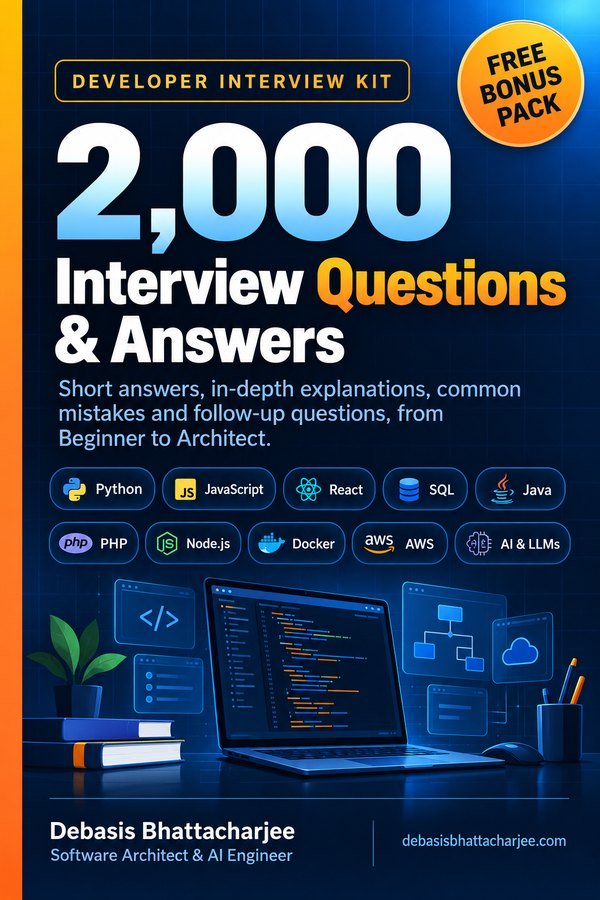
Want all 2,000 questions in one PDF?
- Short answers, in-depth explanations, common mistakes and follow-ups
- 89 topics, from Beginner to Architect, with a clickable contents list
- 226 extra questions that are not on this website
- Free Bonus Pack: 30-day study plan, behavioral questions, salary scripts
Includes 226 extra questions that are not on this site, plus a free Bonus Pack.

Get both books for $9.99 (save $2.99):
The material stays free to read online. This is the organised, offline, print-ready PDF edition. Secure payment by PayPal; your personal download link is emailed after payment is confirmed. Digital product, no shipping.