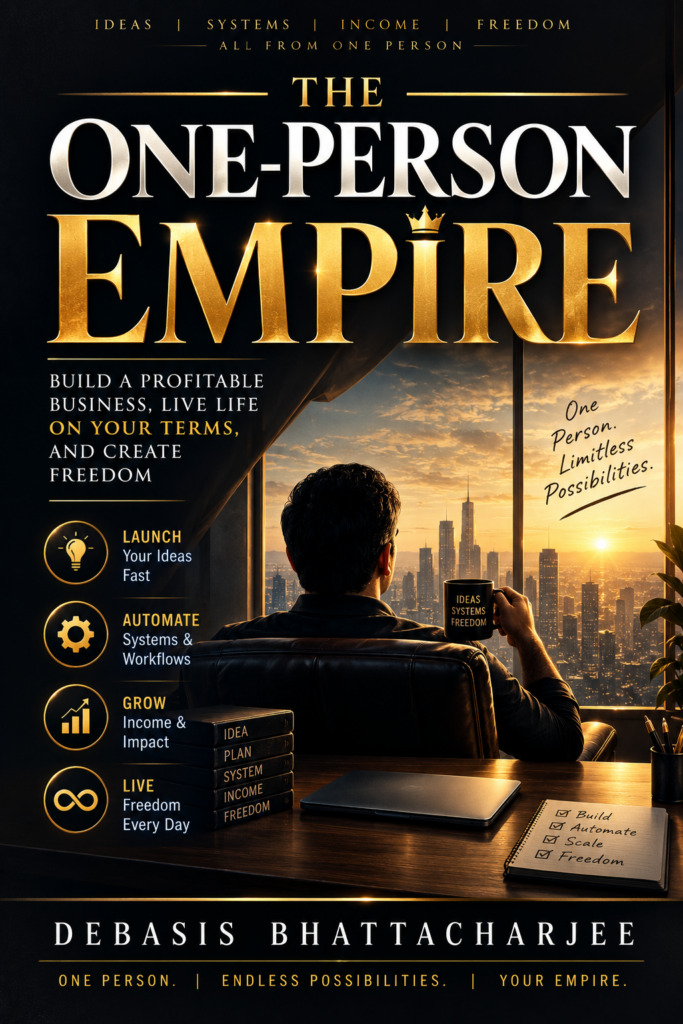
The One-Person Empire
How to build a valuable business without building a huge company — leverage, systems, and pricing for a business of one.
How to build a valuable business without building a huge company — positioning, systems, pricing, and the mindset shift from employee to empire builder.
Introduction: The Rise of the One-Person Empire
The One-Person Empire makes the case that a business doesn’t need headcount to be valuable — it needs leverage. This book is built around four core building blocks (what you sell, how you price, the systems that scale you, and the minimum viable team you actually need) and a “Leverage Ladder” that turns hands-on work into repeatable, higher-value output, without ever requiring you to build a large company.
Maybe you’re a freelancer tired of trading hours for dollars. Maybe you run a small team and wonder if you could do more with less. Maybe you just want proof that “bigger” isn’t the only definition of success. This book walks through positioning, systems, pricing, and the mindset shift that makes a lean, highly-leveraged business of one actually work.
Nine Real Models, Not Just Theory
The book grounds every idea in practice: nine real-world one-person empire models, two full worked examples (freelancer-to-empire, and a day-in-the-life walkthrough), and specific chapters on pricing yourself like a business, marketing as a solo operator, protecting your calendar, avoiding burnout, and money management for a business of one. It closes with the compounding effect that makes year three look nothing like year one, and the core mindset shift from employee thinking to empire-builder thinking.
Chapter-by-Chapter Breakdown
- The Rise of the One-Person Empire
- Why Bigger Is Not Always Better
- The Four Building Blocks of a One-Person Empire
- Choosing What You Actually Sell
- The Leverage Ladder
- Systems That Let One Person Do the Work of Many
- Pricing Yourself Like a Business, Not a Freelancer
- The Minimum Viable Team
- Marketing as a Solo Operator
- Protecting Your Time: The Solo Operator’s Calendar
- Avoiding Burnout in a Business Built Around One Person
- Money Management for a Business of One
- When to Stay Solo and When to Grow
- Common Mistakes One-Person Empires Make
- A Thirty-Day Plan to Start Building Yours
- The Quiet Power of Staying Small on Purpose
- Nine Real-World One-Person Empire Models
- A Worked Example: From Freelancer to One-Person Empire
- Tools That Make This Model Possible
- The Role of Niche and Positioning
- Answering the Doubts That Hold People Back
- Legal and Structural Basics Worth Getting Right Early
- Handling Feast and Famine Income Cycles
- Automation Without Losing the Personal Touch
- A Day in the Life: What Running This Actually Looks Like
- Measuring What Actually Matters
- Negotiating From a Position of Leverage
- The Compounding Effect: Why Year Three Looks Nothing Like Year One
- Building Optionality: Several Small Streams or One Large One
- Preparing for the Long Run
- The Mindset Shift From Employee to Empire Builder
- Three More Examples Worth Learning From
Key Insight: Leverage, Not Headcount
The book’s central claim is that value scales through leverage — systems, positioning, and pricing — not through adding people. A one-person business built around the right leverage points can out-earn a much larger team that hasn’t figured out what to systematize. Staying small is treated as a deliberate strategic choice, not a limitation to eventually outgrow.
“You don’t need a bigger team. You need a better system for the team of one you already are.”
Who Should Read This Book
- Freelancers and solo consultants ready to price and operate like a real business.
- Coaches running a business of one.
- Creators monetizing an audience solo.
- Anyone scaling revenue without hiring a team.
About the Author
Debasis Bhattacharjee is a software entrepreneur, technology strategist, product architect, and the driving force behind Debmedia Technologies LLP.
For years, he has been working at the intersection of software, technology, entrepreneurship, artificial intelligence, SaaS, automation, and digital products—not simply studying these subjects, but turning ideas into working products and real-world solutions.
His journey has been deeply product-driven. From desktop and Windows software to web applications, enterprise solutions, SaaS platforms, AI-powered products, automation systems, utilities, and digital products, Debasis has spent years exploring one fundamental question: how can technology be transformed from an idea into something useful, valuable, and commercially viable?
That philosophy has led him to build and experiment with a large portfolio of software and digital products, while continuously exploring new opportunities created by emerging technologies and changing markets. But technology is only one side of his work — he is equally fascinated by the business behind the product: finding problems worth solving, identifying opportunities others overlook, understanding what people actually need, designing compelling products, creating practical offers, and turning technical capabilities into businesses.
Through his books, he aims to make complex ideas practical — frameworks, mental models, and strategies readers can understand, adapt, and apply, rather than theory for its own sake.
You've Scrolled This Far
for a Reason.
Maybe you want to work together. Maybe you want to discuss something you read. Either way — the conversation costs nothing.
hello@debasisbhattacharjee.com · Mon–Fri, 9AM–6PM IST