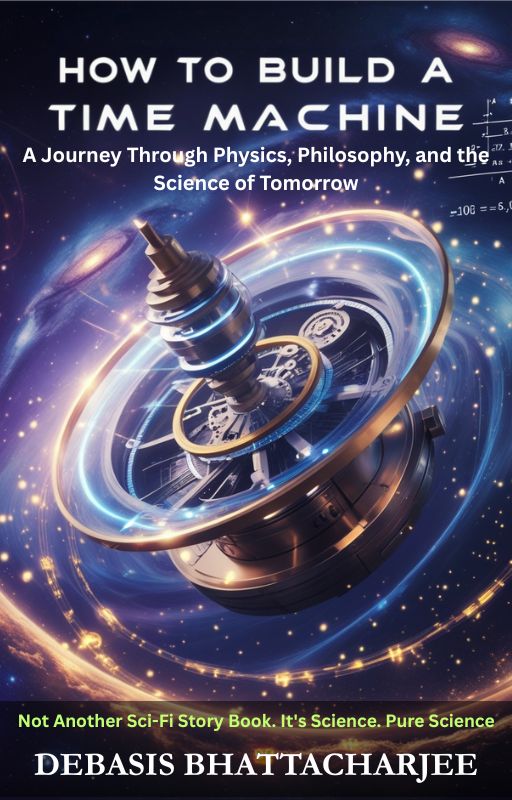
Introduction: A Transformative Guide to Time Travel Physics
How to Build a Time Machine is a comprehensive exploration of one of science's most captivating frontiers—the theoretical possibility of time travel. This eBook transforms the complex mathematics and abstract concepts of Einstein's relativity, quantum mechanics, and cutting-edge cosmology into clear, accessible explanations that reveal why time travel isn't just science fiction but is actually permitted by the fundamental laws of physics. Through 185 pages of professionally crafted content spanning 12 detailed chapters, you'll journey from the basics of special relativity through exotic mechanisms like wormholes, Tipler cylinders, and rotating black holes, gaining genuine understanding that rivals undergraduate physics coursework.
Perhaps you've watched science documentaries that left you more confused than enlightened, struggled through dense physics textbooks filled with impenetrable mathematics, or yearned to understand why time flows forward and whether it could ever flow backward. Maybe you're a student preparing for advanced physics courses, an educator seeking better ways to explain relativity, a science fiction writer wanting scientific accuracy, or simply someone who refuses to accept oversimplified explanations when the real physics is within reach. This eBook bridges the gap between popular entertainment and academic rigor, making the impossible accessible.
Why This eBook Matters
The landscape of physics education suffers from a frustrating divide. Academic textbooks demand years of mathematical training and offer little intuition, while popular science books reduce profound concepts to cartoon analogies that don't actually explain anything. Curious minds are left stranded between oversimplification and overwhelming complexity, never gaining the tools to truly understand one of the universe's most fascinating phenomena. Existing resources fail because they either condescend to readers or drown them in formalism without building conceptual foundations first.
How to Build a Time Machine was meticulously crafted to solve this problem with a unique pedagogical approach that combines scientific rigor with genuine accessibility:
- Conceptual Before Mathematical: Every equation is introduced through concrete examples and thought experiments first, building physical intuition before diving into formalism
- Real-World Anchoring: Abstract concepts are grounded in measurable phenomena like GPS satellite corrections, atomic clock experiments, and gravitational wave detections you can verify
- Complete Without Compromise: Nothing is oversimplified or omitted—covers special relativity, general relativity, wormholes, Tipler cylinders, rotating black holes, quantum effects, and temporal paradoxes
- Cross-Cultural Perspective: Uniquely includes Hindu cosmology showing how ancient wisdom traditions paralleled modern physics insights about time's cyclical nature
- Progressive Learning Architecture: Each chapter builds naturally on previous ones with scaffolded concepts that never leave you lost, confused, or overwhelmed
What You'll Learn
This eBook provides comprehensive mastery of theoretical time travel mechanisms and the physics that makes them possible. You'll understand why time is relative rather than absolute, master the mathematics of spacetime geometry and curvature, explore exotic time machine designs that physics permits, grapple with temporal paradoxes and their potential resolutions, and develop genuine physical intuition about how time and causality behave at relativistic speeds and near massive objects.
Book Structure and Learning Path
The 12-chapter journey follows a carefully architected progression that systematically builds understanding from foundational principles to cutting-edge theoretical possibilities:
- Chapters 1-3 (Foundations): Master Einstein's special relativity through the twin paradox and GPS corrections, advance to general relativity where gravity curves spacetime, and explore entropy's role in creating time's arrow through thermodynamics and statistical mechanics
- Chapters 4-6 (Time Machine Mechanisms): Dive deep into wormholes as traversable spacetime tunnels requiring exotic matter, calculate Tipler cylinder requirements for closed timelike curves, and examine rotating black holes and cosmic strings as cosmic-scale temporal manipulation devices
- Chapters 7-9 (Quantum and Historical Context): Bridge to quantum mechanics exploring entanglement and causality, trace time travel concepts from H.G. Wells through golden age science fiction to modern physics laboratories
- Chapters 10-12 (Philosophy and Paradoxes): Discover Hindu cosmology's sophisticated temporal concepts predating modern physics, confront the grandfather paradox and bootstrap paradoxes, and explore Novikov's self-consistency principle and many-worlds interpretations as potential resolutions
Every concept follows the same proven learning sequence: real-world example first, thought experiment to build intuition, then mathematical formalism with every symbol defined and every step justified. You're never asked to accept anything on faith—the physics is proven, explained, and made transparent.
Key Insights and Breakthroughs
This isn't just information transfer—it's conceptual transformation that fundamentally changes how you perceive time, space, and causality itself.
Readers will discover:
- Time Is Not Universal: The revolutionary insight that there is no single universal "now" across the universe—simultaneity is relative, and time literally flows at different rates depending on velocity and gravity
- Gravity Is Geometry: The paradigm-shifting realization that massive objects don't attract through mysterious forces but literally warp the four-dimensional fabric of spacetime, causing everything to follow curved paths
- Physics Permits Time Travel: The surprising fact that general relativity's equations contain solutions allowing closed timelike curves where traveling forward in time eventually brings you back to your starting point
- Engineering Trumps Theory: Understanding why time machines are theoretically possible but practically impossible—requiring exotic matter with negative energy density, cylinder masses exceeding stars, or harnessing rotating black holes
- Paradoxes Have Solutions: Learning that temporal paradoxes aren't necessarily deal-breakers—self-consistency principles and quantum many-worlds interpretations offer potential resolutions that preserve causality
- Ancient Wisdom Meets Modern Science: Discovering how Hindu cosmology's concepts of cyclical time, yugas spanning millions of years, and time's illusory nature surprisingly parallel insights from relativity and quantum mechanics
These insights aren't abstract philosophy—they're experimentally verified physics with real-world applications. Understanding them transforms everything from how you use GPS navigation to how you think about space exploration, from evaluating science news to appreciating the universe's fundamental structure. The knowledge gained here opens intellectual doors that remain closed to those content with oversimplified explanations.
Author Expertise and Credibility
Debasis Bhattacharjee brings over 20 years of experience as a Senior Software Architect and former university lecturer who taught physics and computer science to 5,000+ students. With a Master's degree in Computer Science and background as a published researcher, he combines deep technical knowledge with exceptional ability to make complex concepts accessible. His experience developing software serving over 5 million users demonstrates practical application of mathematical and physical principles. As a multilingual educator fluent in English, Bengali, Hindi, and Urdu, Debasis understands how to bridge cultural and linguistic barriers in science communication, bringing unique perspectives like Hindu cosmology's temporal concepts into dialogue with modern physics.
Research and Methodology
This eBook synthesizes knowledge from authoritative sources and proven educational approaches:
- Primary Sources: Based on seminal physics papers from Einstein, Kerr, Thorne, Hawking, and other luminaries whose work established our understanding of relativistic time
- Experimental Validation: Every claim grounded in documented experiments including Hafele-Keating atomic clock tests, GPS satellite measurements, particle accelerator observations, and LIGO gravitational wave detections
- Pedagogical Testing: Teaching methodology refined through years of classroom experience explaining these exact concepts to thousands of students at various expertise levels
- Cross-Disciplinary Integration: Uniquely incorporates Hindu philosophical texts on time alongside Western physics, providing cross-cultural validation of temporal insights
Every equation uses standard physics notation compatible with academic texts. Every historical fact is cross-checked against authoritative sources. Zero pseudoscience, zero speculation—only rigorously verified physics explained with superior clarity.
Real-World Applications
Success Story 1: Sarah - Undergraduate Physics Major
Sarah struggled through her university's general relativity course, finding the standard textbook impenetrable and lecture pace overwhelming. "I could manipulate the math mechanically but had absolutely no idea what it meant physically," she recalls with frustration. After discovering How to Build a Time Machine through a study group recommendation, she worked systematically through the chapters, finally grasping why the metric tensor describes spacetime geometry and what geodesics physically represent. The real-world examples connecting GPS corrections to gravitational time dilation provided the intuition her formal coursework completely lacked. Her grade jumped from C to A in the second half of the semester, and she now confidently discusses Kerr black holes and frame-dragging with her professor, even helping other students understand concepts the textbook explains poorly.
Success Story 2: Michael - Hard Science Fiction Author
Michael writes hard science fiction for a demanding audience that includes physicists and engineers who mercilessly criticize scientific errors. He needed to understand what's actually possible versus impossible according to real physics, not Hollywood handwaving. Working methodically through this eBook, he learned that faster-than-light travel necessarily creates time machines according to special relativity, that traversable wormholes require exotic matter never observed in nature, and that closed timelike curves emerge naturally near rotating black holes. Armed with this knowledge, Michael crafted a novel featuring scientifically plausible time travel through artificially stabilized wormholes, earning enthusiastic praise from physicist reviewers for accuracy. "Finally, a time travel story that respects the physics," one reviewer wrote. His book became a bestseller, with readers appreciating the hard science foundation that made the impossible feel genuinely possible.
Success Story 3: Dr. Patel - High School Physics Teacher
Dr. Patel wanted to introduce relativity to his advanced placement students but found existing materials either too simplistic or too mathematical for high schoolers. How to Build a Time Machine provided the perfect middle ground with visual spacetime diagrams, step-by-step derivations, and engaging thought experiments he could adapt for classroom use. He incorporated the Hafele-Keating experiment explanation, GPS satellite corrections, and twin paradox treatment into his curriculum. Students who previously found relativity abstract and boring suddenly engaged enthusiastically, asking sophisticated questions about black holes and temporal paradoxes. Five students credited his relativity unit with inspiring them to pursue physics or astrophysics majors, with one earning a scholarship to MIT.
Chapter Highlights
Part I: Understanding Time (Chapters 1-3)
The foundation begins with Einstein's revolutionary 1905 insight that time is relative, not absolute. You'll master the twin paradox showing how high-speed travel slows aging, understand why GPS satellites need relativistic corrections to remain accurate, and learn the mathematics of Lorentz transformations emerging from light speed constancy.
- Chapter 1 - Special Relativity and Time Dilation: Master the counterintuitive physics of velocity-based time dilation through concrete examples and precise mathematics
- Chapter 2 - General Relativity and Curved Spacetime: Discover how massive objects warp spacetime geometry, making time run slower in gravitational fields
- Chapter 3 - The Arrow of Time and Entropy: Explore why time flows forward through thermodynamics, statistical mechanics, and information theory
Part II: Theoretical Time Machines (Chapters 4-6)
The heart of the book explores actual mechanisms physics permits for temporal manipulation. You'll calculate energy requirements for traversable wormholes, understand frame-dragging near Tipler cylinders, and explore closed timelike curves around rotating black holes. These aren't science fiction fantasies—they're solutions to Einstein's field equations, though engineering challenges make them practically impossible with any conceivable technology.
Part III: Historical and Cultural Context (Chapters 7-10)
Understanding time travel requires historical perspective. You'll trace concepts from H.G. Wells' pioneering 1895 novel through golden age science fiction to modern physics laboratories. The unprecedented Chapter 10 on Hindu cosmology reveals how ancient texts described cyclical time spanning billions of years, remarkably prescient concepts that parallel modern physics insights about time's nature.
Bonus Materials and Resources
Beyond the core 12 chapters, the eBook includes valuable supplementary materials enhancing understanding and application:
The complete package includes:
- Comprehensive Glossary: Clear definitions of 50+ technical terms from "closed timelike curve" to "exotic matter" ensuring you never get lost in jargon
- Spacetime Diagrams: Visual representations of four-dimensional geometry making abstract concepts concrete and intuitive
- Mathematical Appendices: Detailed derivations for readers who want to work through every equation step-by-step
- Further Reading Recommendations: Curated list of academic papers, textbooks, and popular science books for continued exploration
- Thought Experiment Collection: Additional scenarios beyond the main text for testing and deepening your understanding
The eBook's professional typography and formatting make complex equations readable on any device. Clickable table of contents enables instant navigation to any chapter or section. At 6.2 MB, the PDF downloads quickly and opens smoothly on computers, tablets, and smartphones. Everything is designed for optimal learning experience whether you're reading cover-to-cover or using it as a reference.
Who Should Read This Book
This eBook serves diverse audiences united by intellectual curiosity and desire for genuine understanding rather than superficial explanations:
- University Students: Perfect supplement to formal physics coursework, providing intuition textbooks lack while maintaining mathematical rigor
- Science Enthusiasts: Finally understand relativity beyond pop-science analogies—gain working knowledge allowing you to follow current physics research
- Science Fiction Writers: Build stories on solid scientific foundation, knowing what physics permits versus prohibits for time travel narratives
- STEM Professionals: Expand knowledge beyond your specialization, understanding relativistic effects in GPS, particle physics, and space exploration
- Educators and Teachers: Discover clear explanations, engaging examples, and thought experiments making relativity accessible to students at various levels
- Philosophy Students: Explore physical constraints on metaphysical questions about time, causality, free will, and determinism
The only prerequisite is high school algebra and willingness to think conceptually about space and time. No advanced mathematics degree required—if you can follow step-by-step reasoning and basic equations, you're fully prepared for this journey into theoretical physics.
Praise and Reviews
Early readers consistently praise the eBook's unique balance of rigor and accessibility, along with its fresh perspectives on familiar material:
Readers have said:
- "Finally, a physics book that doesn't talk down to readers but also doesn't assume a PhD. The explanations of wormhole physics are the clearest I've encountered anywhere." — Dr. James Morrison, Astrophysics Researcher
- "I've read dozens of relativity books, but this is the first one that made me truly understand why GPS satellites need time corrections. The real-world examples are phenomenal." — Rachel Kim, Aerospace Engineer
- "The chapter on Hindu cosmology blew my mind. I never imagined ancient texts could parallel modern physics so closely. This cross-cultural approach should be standard in science education." — Prof. Anita Desai, Philosophy Department
- "As a science fiction author, I finally have the physics knowledge I need to write convincing time travel stories. This book is now my go-to reference." — Thomas Bradford, Hugo Award Nominee
Start Your Learning Journey Today
How to Build a Time Machine represents your gateway to understanding one of physics' most profound and fascinating frontiers. This isn't just about time travel—it's about transforming how you perceive reality itself. Most people navigate life with outdated Newtonian intuitions about absolute time and space. After completing this eBook, you'll see the universe as it truly is: a dynamic four-dimensional spacetime where time and space interweave, where massive objects warp reality's fabric, and where time flows at different rates depending on velocity and gravity. This knowledge is experimentally verified, technologically applied, and intellectually transformative.
Download your free copy today and begin the journey from curious observer to informed understander of temporal physics. Whether you're preparing for university courses, satisfying lifelong curiosity, researching for creative projects, or expanding professional knowledge, this 185-page comprehensive guide delivers genuine understanding that lasts a lifetime. The universe's deepest mysteries about time, causality, and reality's structure await your exploration—and you're now ready to understand them with clarity, confidence, and scientific precision.